
Whether you have just moved to Calgary, changed jobs, or simply want a better dental experience, transferring your records to a new clinic does not have to be stressful. This step-by-step guide walks you through the entire process—from requesting your files to choosing a Calgary dental clinic that welcomes every insurance plan.
Why Transferring Your Dental Records Matters
Skipping the records transfer might seem tempting, but your new dentist needs your complete history to deliver safe, informed care. Past X-rays reveal bone changes, hidden decay, and the performance of previous restorations. Treatment notes explain sensitivity, root-canal history, and orthodontic movements. With this context your provider can choose appropriate imaging, catch risks earlier, and recommend treatments that are both conservative and effective.
Continuity of care depends on this history. When your new dentist can review prior findings, they avoid guesswork and build on what already works, supporting stable outcomes and better monitoring of conditions like gum disease or bruxism.
Your Legal Rights to Dental Records in Alberta
Before you begin, it helps to understand the law. In Canada, your dental records belong to you. Even if you have an unpaid bill or a fee dispute with your previous dentist, they cannot refuse to transfer your records. Your dental history, X-rays, treatment notes, and other documents must be provided to your new dentist when requested.
Alberta's Health Information Act requires dental practices to maintain strict patient confidentiality protocols when transferring your information. Your current dentist cannot refuse to release your records, though they may charge reasonable copying fees for duplicating X-rays and charts. If a practice resists, you can document your communication attempts and reference Alberta's Health Information Act requirements, or escalate to the Alberta Dental Association and College (ADA&C).
Step-by-Step: How to Transfer Your Dental Records in Calgary
Step 1 — Choose Your New Dental Clinic First
Before requesting records, identify the clinic you want to move to. If insurance flexibility is a priority, look for a practice that accepts all national plans and offers direct billing. For example, Pathways Dental Clinic in NE Calgary accepts all national plans and does direct billing for most insurance companies, and bills at or below the latest ADA&C Dental Fee Guide.
Step 2 — Contact Your Previous Dental Office
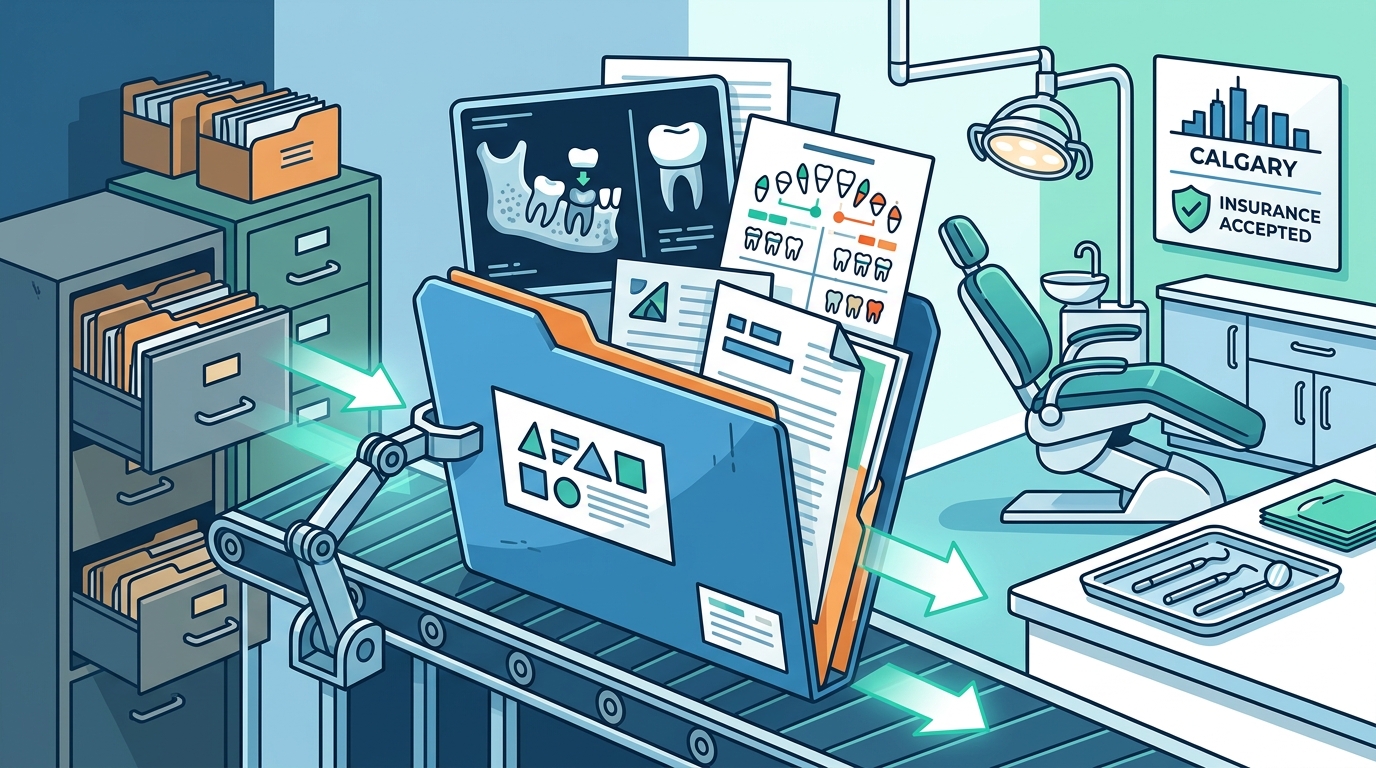
Reach out to your former clinic at least two weeks before your first appointment at the new practice. This lead time allows seven to ten business days for processing. Ask for digital copies of X-rays (often in DICOM or JPEG format), clinical notes, periodontal charts, and any orthodontic evaluations. Confirm whether there is a fee, the formats available, and the typical processing time.
Step 3 — Sign a Records Release or Consent Form
Your new dental office will have you sign a simple release form. This form gives them permission to contact your previous dentist and request your dental records. In many cases, your new practice can handle the entire request on your behalf—you just need to authorize it.
Step 4 — Choose a Transfer Method
Most offices transfer records digitally between practices or provide sealed copies for you to transport. You can request that files be emailed securely, uploaded to a patient portal, or provided on an encrypted drive. If you prefer, you can also schedule an in-person pickup with proper identification.
Step 5 — Verify Everything Arrived
After the transfer, confirm with your new clinic that all records were received completely. Ensure both practices coordinate using the signed consent forms. A quick phone call or email can prevent gaps in your treatment history.
What Your Dental Records Include
- Personal information: legal name, date of birth, address, emergency contacts, and primary care physician
- Medical and dental history: past diagnostics, allergies, medications, and doctor's notes
- Clinical records: treatment notes, periodontal charts, and charting of existing restorations
- Diagnostic imaging: current and historical X-rays, intraoral photos, and digital scans
- Financial and insurance details: invoicing, itemized costs, payment agreements, and benefits information on file
- Consent documentation: records confirming informed consent for previous treatments
How Much Does It Cost to Transfer Dental Records?
Generally, transferring your dental records is free. Your old dentist can choose to charge a reasonable administrative fee for time and materials required to duplicate and send your records. In Alberta, fees must represent reasonable cost recovery and cannot create financial barriers for patients. Importantly, a dentist may not withhold your records because of an outstanding account balance—this is a clear legal requirement.
What If Your Former Dentist Delays or Refuses?
In most cases, dental offices comply quickly once they understand the legal requirements. If resistance continues, take these steps:
- Document all communication attempts in writing.
- Send a formal letter referencing your legal right to access records under Alberta's Health Information Act.
- Contact the Alberta Dental Association and College (ADA&C), which can investigate complaints about record withholding and ensure compliance with professional standards.
Choosing a Calgary Dental Clinic That Accepts All Insurance Plans
Not every dental office in Calgary works with every insurer. When searching for maximum coverage flexibility, look for clinics that:
- Accept all major private insurance plans — including Blue Cross, Sun Life, Manulife, and others
- Offer direct billing — the clinic submits claims electronically so you pay only your co-payment at the chair
- Participate in the Canadian Dental Care Plan (CDCP) — a federal program for Canadians without private insurance and with household income under $90,000
- Accept government programs — such as Alberta Child Health Benefit (ACHB), Alberta Adult Health Benefit (AAHB), AISH, Seniors' benefits, Veterans Coverage, and Non-Insured Health Benefits (NIHB)
- Follow the Alberta Dental Fee Guide — so your insurance reimbursement aligns closely with the clinic's fees, minimizing out-of-pocket costs
Why Pathways Dental Clinic Checks Every Box
Pathways Dental Clinic, located at Bay 22, 3220 5 Avenue NE in Calgary, is an affordable, family-friendly practice led by Dr. Tony Kim, Dr. Derek Bouma, and Dr. Adam Lei. The clinic accepts all national insurance plans and does direct billing for most insurance companies. They bill at or below the latest ADA&C Dental Fee Guide, keeping costs predictable for patients regardless of their plan.
Pathways Dental offers a comprehensive range of services—from general and children's dentistry to dental implants, orthodontics (including Invisalign), sedation dentistry, and cosmetic treatments. Extended evening hours until 8:00 pm and Saturday appointments make scheduling easy, and the clinic is currently accepting new patients with a $1 new-patient exam offer.
Understanding Insurance Fee Guides in Alberta
Alberta does not have a single standard fee guide. Each insurance company sets its own fee guide and pays claims as a percentage of that rate. Even when a plan states it provides 100% coverage, the coverage rate may be based on the insurance company's fee schedule, not the dental office's fees. When the two guides do not align, patients are responsible for paying the difference.
Choosing a clinic that follows the Alberta Dental Fee Guide—or bills below it—helps minimize these gaps. At Pathways Dental, some fees are even below the guide, reducing the chance of unexpected charges.
Key Takeaways
- Your dental records legally belong to you in Alberta, and no dentist can withhold them—even over unpaid bills.
- Request your records at least two weeks before your new appointment to allow adequate processing time.
- Your new clinic can often handle the transfer request for you after you sign a consent form.
- Transfers are usually free, though a small administrative fee may apply.
- Choose a clinic that accepts all insurance plans, offers direct billing, and follows the provincial fee guide to keep costs predictable.
- Pathways Dental Clinic in NE Calgary accepts all national plans, bills at the fee guide, and welcomes new patients with extended hours and affordable pricing.
Frequently Asked Questions
How long does it take to transfer dental records in Calgary?
The release and transfer of dental records should typically be accomplished within one to two weeks of receipt of the request. Processing time may vary depending on the number and type of records requested and whether physical duplication of X-rays or models is needed.
Can my old dentist refuse to release my records if I owe money?
No. It is unacceptable to withhold the transfer of records because of an outstanding account balance. Fee disputes should never be grounds for blocking access to your dental files.
Do I need to notify my old dentist that I am switching?
There is no legal obligation to explain why you are leaving. You can simply sign a release form at your new clinic, and they will handle the records request. You will not face any penalties or fees for deciding to switch dentists.
Does Pathways Dental Clinic accept the Canadian Dental Care Plan (CDCP)?
Yes. Pathways Dental Clinic participates in the Canadian Dental Benefit Program and accepts patients under government coverage programs in addition to all private insurance plans.
What if my previous dentist used paper records instead of digital?
Your former clinic is still required to provide copies. They can duplicate X-rays onto film, photographic paper, or appropriate digital formats. Study models can also be duplicated or photographed in diagnostic-quality digital images.
Is there a charge to transfer dental records?
Many offices provide records at no charge. However, your previous dentist may charge a reasonable administrative fee for copying and transmitting files. They must provide you with a fee estimate before proceeding.